June 26, 2017

Day 6: The Next Stop on our Tour is Zakopane

We did not go 135 meters underground into a salt mine, nor did we go to the top of a 1,120 meter mountain. In spite of our plans to do both, Earth kept us on her surface today.

On our way out of Krakow, the three of us attempted to visit the Wieliczka Salt Mine, one of the rare tourist destinations in this area that my mom had never been to before. After transportation hassles too dull to account here, we learned that the wheelchair-accessible tour only ran twice a day and we were either 2 hours late or 6 hours early. My mom could not climb 800 steps on a fractured foot, and leaving her behind for 2 hours was out of the question.


I felt bad about not researching the mine tours more carefully before showing up there.

Traffic made our 2-hour drive to Zakopane into a 4-hour one. By the time we arrived, it was probably just as well we hadn’t stayed longer at the mine. Everyone was weary. Even good-natured Evie, usually up for everything, asked if she could skip dinner and have some relaxing time alone.

While my tired tween recharged, my mother and I ate our fanciest meal of the trip; she had traditional flaki which she hadn’t tasted in almost 20 years. She stopped cooking it after my dad died; she didn’t see the point when nobody else was there to enjoy it with her. I tried a Polish duck dish, but couldn’t bring myself to have tripe with my mom.

After dinner, Evie wanted to take a cable car to the top of a mountain, but we got lost and walked in circles for half an hour before realizing we were too late. Instead, I bought her cotton candy and pizza, and I felt bad about not researching the cable car schedule more carefully.

There’s a group of Americans staying at our hotel. They’re on a two-week guided tour through Poland. I'm a little jealous. They don’t have to drive winding mountain roads in silent prayer to the patron saint of manual transmissions (St. Frances of Rome) or figure out how to open the gas tank of a rental car. They don’t have to know when things are open or how accessible they are. These tourists have paid someone else to sort out the details, and they just show up and enjoy. I asked a couple of them for directions to the mountain cable car, and they shrugged: “We just got dropped off there.”

Then I look through the pictures of my day and remember where I am and how I got here.

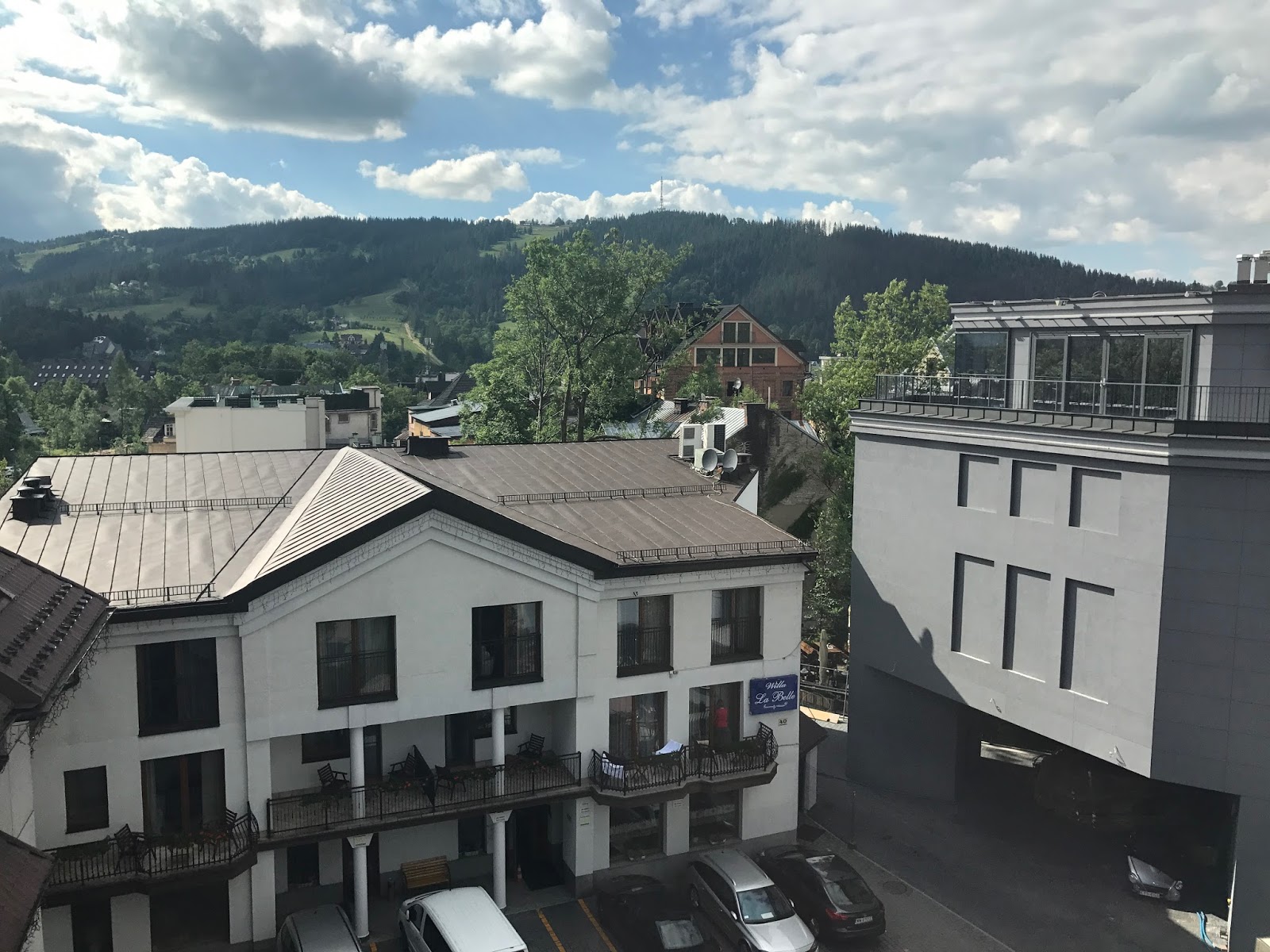
I’m in a charming town in the scenic Tatra Mountains.


There are carts on every corner selling hunks of delicious cheese.


My daughter didn’t get to a mountaintop, but she did have some moments of pure joy.


My mother didn’t get to explore the salt mine, but she did get to eat ice cream with her granddaughter and traditional Polish food with her daughter.  

I even got a non-selfie photo of me, the first of my trip.


I’m not a perfect tour guide, but I think I’m doing OK. I am going to allow myself to be proud of how far I have gotten us, and how much fun we have had.

St. Frances, I hope you’re ready to help us get to Lodz tomorrow, where my aunts and cousins will enthusiastically greet us - and take over as tour guides.


June 25, 2017

Day 5: More photos than words


Today, we visited the hills south of Krakow, the area where the second half of my grandparents' World War II story takes place. It is a primary setting for the novel I'm working on. I will find many, many words to write about this place.

But today, I just want to show you the photos.

Myslenice, where my grandfather's Underground Army (Armia Krajowa) unit was headquartered.


Dobcycze, another town in his area of command.


A memorial to the Armia Krajowa on a hill where my grandfather's unit fought against Nazi soldiers:


The view from that hill:


This rooster, who saw me trying to back up the station wagon at the top of his hill and wanted to make sure I knew who was boss:


Szczyrzyc, a monastery which gave supplies to the Resistance. My mom remembers walking here, and riding in a horse-drawn carriage to attend church and to buy candy in the town. Also, a Polish name that I am completely unable to pronounce.


The church in Gora Jana, where my mom was baptized.


A cemetery where many of my relatives are buried:


The road to Gora Jana, which my mother remembers full of dairy pastures and ramshackle cottages. Today, it is home to acres of apple orchards.


Good night, friends. I'll have more words for you tomorrow.


June 24, 2017

Day 4: Polska Walczy

On a Sunday morning in the fall of 1942, my grandfather, Major Antoni Wegrzyn, walked into the Church of St. Wojiech in Krakow at 9 a.m. sharp. He was scheduled to meet with his new commander, Major Galica, of the Polish Underground Army, or Armia Krajowa.

Major Galica was supposed to meet him in the confessional at the left of the altar, but he never arrived. At 9:45, my grandfather left. He later found out that he’d been mistaken about the time of the meeting. Had he arrived on time, at 10 a.m., he would have been arrested by the same Gestapo agents who had arrested Major Galica two days earlier.

On a Saturday evening 75 years later, my 10-year-old daughter and I walked up to the same church. It’s a tiny church, older than the rest of Krakow’s central square, and completely dwarfed by it. Tonight, there was a rock concert happening next to it.

Church at left, concert at right. The crowd was not assembled for evening prayer.


Inside the church, Evie and I lit two candles. I lit mine with a prayer of gratitude for my grandfather’s life, and Evie lit hers for my mother.

Their meeting spot was the confessional, just to the left of the altar.

I knelt and I prayed in thanks for this moment and tried to imagine that other moment 75 years ago. I tried to picture the grandfather who died when I was 5 and whom I only know from photos and anecdotes.

Evie learned a lot about our family's history and World War II today, thanks to several hours at the Museum Armii Krajowa.  

Morse Code < texting

Officially, the Polish Army was defeated barely a month after the Germans invaded in 1939. However, through more than 5 years of occupation, Poland never stopped fighting. The Polish resistance was large, well organized, and more successful than history gave it credit for. Since the other invaders, the Soviets, ended up controlling Poland after the war, they got to write the history books - and imprisoned the leaders after the war.

My grandfather, code name Ostroga, was one of the resisters. I learned his story by translating his memoirs, and today I went to the museum of the resistance army (Armia Krajowa) to see some relevant artifacts and historical context.

At the beginning of the occupation, my grandfather's primary role was Intelligence, gathering and distributing underground newspapers, coded messages, and other important information for the resistance.

Examples of pamphlets he might have carried
My grandmother also was a resister; she led a secret Polish school in a time when the Germans forbid post-secondary education and the teaching of history.

Evie enjoyed hearing that children participated in the resistance by spreading graffiti and counter-propaganda. 


The symbol of the resistance, an anchor made of the letters PW: Polska Walczy (Poland Fights)


From 1944 to 1945, my grandfather led a 90-member partisan unit called Poscig (Chase) in a remote area south of Krakow.

This wasn't his gear, but it feels like it could have been.


Tomorrow, I am taking Evie and my mom to see the villages and sites where the brave men of Poscig trained, fought, and refused to accept defeat. 


Even though I don’t have any childhood memories of my grandfather, I have some from today, and I will make new ones tomorrow. That is the miracle of this trip, for which I will light another candle in another church tomorrow.


June 23, 2017

Day 3: The Road to Krakow


My proudest accomplishment of the trip so far: I got my rental station wagon out of a tiny underground parking garage and into another one 300 km away.

In between, I saw a stretch of central-to-southern Poland that sometimes reminded me of Minnesota or Wisconsin, and that sometimes felt like a place I’ve only been in old memories or dreams. Little churches with huge cemeteries, evergreen forests so dense that light can’t reach the bottom branches, pastures with cows the color of butterscotch milkshakes.

Wildflowers in abundant bursts: white, purple, and the distinctly Polish red poppy.


We paused at a random rural cemetery to look around. The graves were well tended, and the holy monuments seemed to attract a lot of prayers and floral offerings. Although we didn’t see a living soul, there was no doubt of their devotion.


I realized how little of my Polish Catholic upbringing I passed on to my daughter during a tour of Krakow this evening. Within minutes of me telling the tour guide, “Of course I know who Karol Wojytla was,” Evie asked, “What’s a nun?”

It was decided that I would show Evie some churches during this trip; this should pose little difficulty as there are well over 100 in Krakow alone.


The first one I’d like to visit is St. Wojciech, also called St. Adalbert, which is mentioned in my grandfather’s memoirs. I’ll share more of the story tomorrow; it’s a good one.

Our tour, a golf-cart outing we splurged on after my mom’s wheelchair proved no match for cobblestone streets, also took us through the Kazimierz Jewish district and the Krakow Ghetto.

Poland has a way of juxtaposing the beautiful, the tragic, and the mundane.

At the central square of the Krakow ghetto, where thousands of Jewish people were imprisoned and murdered, empty chairs stand. I was startled to see a billboard for smartphones and a bar across the street. Then I reminded myself that, if every tragic site was forever frozen in its history, we would have no ground to walk upon lightly – especially in Poland. Nonetheless, I was glad to see the chairs, and that nobody was walking between them.


I looked at Evie through my tears to see how this part of the tour was affecting her. She was just watching and listening, and I saw my own reflection in her mirrored sunglasses.

A couple hours later, she asked me if the people who killed the Jewish people during the war were Christians, and whether they believed that they were doing good.

I fumbled my way through, trying to think of a smart answer, and coming up short. It's too easy to say it was all about religion, or not about religion, or any other simple explanation that fits into a sentence or two.

I told her to keep asking questions like that. And to pray for people all over the world to see one another's humanity, to stand against injustice, and to learn from history.